नोट
Learning About Red-Breasted Mergansers Key Facts and Insights
When we think of ducks, we often picture birds that munch on pond weeds and other green plants—round, highly buoyant creatures that bob on the water’s surface like floating bath toys. But there’s at least one group of ducks that defies all these common assumptions. Mergansers, a genus of ducks, retain the raptor-like traits of their ancestors, and the red-breasted merganser stands out as an exceptional example of this. The reddish breast that gives this species its common name is most visible in males when they have their breeding plumage.
Hannah Scott
लेखक
मेटा
संदर्भ फील्ड नीचे उपलब्ध।
टाइप
पल्स नोट
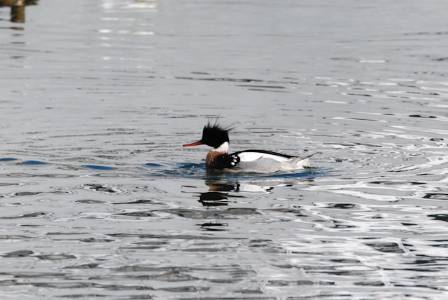
When we think of ducks, we often picture birds that munch on pond weeds and other green plants—round, highly buoyant creatures that bob on the water’s surface like floating bath toys. But there’s at least one group of ducks that defies all these common assumptions. Mergansers, a genus of ducks, retain the raptor-like traits of their ancestors, and the red-breasted merganser stands out as an exceptional example of this. The reddish breast that gives this species its common name is most visible in males when they have their breeding plumage.
Red-Breasted Merganser Profile
The red-breasted merganser is likely the fastest duck in the world. It has a streamlined body with an unusual shape—featuring a long neck and strong, propulsive feet that help it dive to catch its main food source: fish. This duck has a specialized beak and a one-of-a-kind mating display, and these traits have served the species well. As a result, red-breasted mergansers are common across most of the Northern Hemisphere and exist in large numbers. Each year, they migrate from the lakes and rivers where they breed to warmer coastal areas where they spend the winter. These social ducks break the mold in more ways than one, even setting records in the process.
Red-Breasted Merganser Facts Overview
The red-breasted merganser is possibly the fastest duck there is. It’s a streamlined, weirdly-proportioned bird, with a long neck and powerful propelling feet for diving to catch its food: fish. It has a specialised beak and a unique mating display, and these seem to have worked well for the species, as they’re common in most of the Northern Hemisphere and in huge numbers. They migrate each year from lakes and rivers where they breed, to warmer coastal wintering areas. These social ducks defy convention in more ways than one and break records while they’re doing it.
Interesting Red-Breasted Merganser Facts
1. This is no ordinary duck
Scientifically known as Mergus serrator, the red-breasted merganser looks like a duck and swims like a duck—but a closer look reveals something unusual. It’s part of a group called “sawbills,” and its beak is very different from that of common ducks like mallards, pochards, or shovelers, all of which have wider, flatter beaks. A bird’s beak shape tells you a lot about its lifestyle, and sawbills have sharp, narrow, dart-like beaks covered in serrations. All duck species have some form of these serrations, often as tiny, comb-like structures called lamellae that help trap algae and plant matter from the mud they feed on. In mergansers, however, these serrations are larger and sharper, forming tooth-like protrusions. This type of beak is perfect for catching fish: while ducks with flatter beaks nibble on grass and sift through plant matter, mergansers actively hunt for prey. These “teeth” even inspired the duck’s Latin species name, serrator (meaning “sawyer”), and help it grip onto fish tightly. While many duck species will eat a fish or two if they can catch them, most are mainly vegetarian. Mergansers are unusual because fish make up the majority of their diet.
2. They have a hankering for salmon
During duck hunting season in northeastern Scotland, researchers get a unique—though somewhat gruesome—chance to study the diets of red-breasted mergansers by examining their stomach contents. What they’ve found is remarkable: these ducks are such skilled hunters that they can even catch and eat salmon, one of the strongest swimmers in freshwater. Juvenile salmon make up as much as 91% of the merganser’s diet in this region, showing a clear preference for this fish. This makes red-breasted mergansers a significant predator, and as a result, they exert a notable selective pressure on local salmon populations. The salmon they eat can be up to 115 millimeters long—roughly one-fifth the length of the merganser itself.
3. So fishermen don’t like them
Red-breasted mergansers are hunted for food by humans across their range, but in some cases, they’re targeted specifically as pests. Anglers see them as competitors, since both go after fish, and fish farmers accuse the ducks of reducing their stocks. The combined pressure from these groups likely impacts the species’ numbers, though just how significant this impact is has not yet been fully studied or confirmed.
4. Still, they’re doing ok
In some areas, red-breasted merganser populations face threats beyond conflicts with fishermen. These include poisoning from pesticides and the destruction of their natural habitats. However, on a global scale, these ducks are so widespread and abundant that conservationists consider them a “Least Concern” species. Their global population is also thought to be stable, meaning they’re not at risk of widespread decline right now.
5. They don’t quack like a duck
Another clue that the red-breasted merganser is no ordinary duck comes from the sounds it makes or rather, the sounds it doesn’t make. This is a very quiet duck, unlike its noisy, quacking relatives, and it tends to stay silent most of the time. That changes, though, once breeding season arrives. When hormones kick in, these birds produce a range of unusual sounds. Male mergansers’ mating calls have a cat-like quality: they either let out loud “yeow” noises or softer purring sounds. Females respond with a low, bark-like call, which only adds to how un-duck-like these birds seem. Males also perform cute mating displays, one of which is called a “salute-courtesy.” During this display, the male stretches its long neck upward in a “salute,” then follows up with a bow that dips part of its body under the water’s surface. After that, it swims in front of the females it’s trying to impress, bobs its head a few times, and repeats the whole sequence.
6. They like to spend Winter on the coast
Red-breasted mergansers breed in freshwater habitats like lakes and rivers, but they’re migratory birds. When winter comes, they move to warmer coastal areas. These ducks have even been spotted spending the winter in the West Indies, choosing a tropical coastal climate that many freshwater duck species would not tolerate.
7. They’re quite social
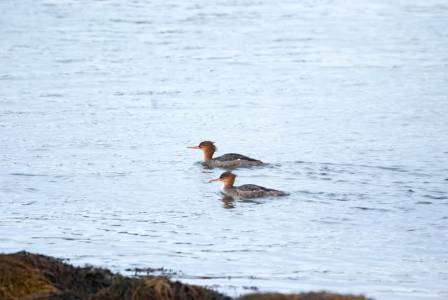
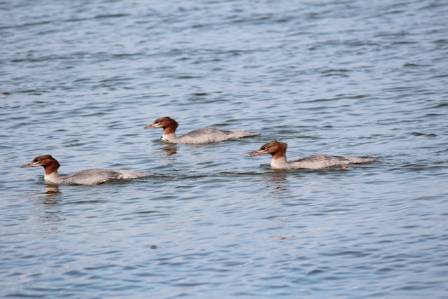
Red-breasted mergansers enjoy company when they’re on the move. Flocks of migrating mergansers can often have up to 100 members, and when they gather on the water, they’ve been known to form massive groups of as many as 15,000 birds. They’re not fussy about who they associate with, either—they’ll share space with members of other bird species and aren’t particularly territorial or defensive about their feeding or resting spots. Only during breeding season do individual mergansers leave the group to find a mate and nest on their own.
8. And they can really move
Ducks are known for being fast, but the red-breasted merganser holds the record for the highest ground speed ever officially recorded for any bird. In one instance, when chased by a plane, these ducks maintained a speed of 129 kilometers per hour (80 miles per hour). With a 32-kilometer-per-hour (20-mile-per-hour) tailwind, this would have translated to a ground speed of up to 161 kilometers per hour (100 miles per hour)—faster than any other known duck! In fact, they ranked second in research on the world’s fastest flying birds and animals.
9. They can dive, too
One of the most well-known traits of this predatory duck is its impressive diving ability. Its sleek head, agile body, and pointed beak let it dive deep to catch fish sometimes going as far down as nine meters! These dives can last nearly a minute. The merganser’s feet, which are positioned far back on its body, help give it powerful propulsion underwater. However, this foot placement makes the duck walk in a rather awkward, clumsy way on land.
Conclusion
The red-breasted merganser is a fascinating duck that breaks almost every stereotype we have about these birds. From its raptor-like hunting skills and saw-like beak to its record-breaking speed and unusual social habits, it’s a species that showcases just how diverse and adaptable ducks can be. While it faces some local threats, its global stability is a positive sign, allowing us to continue studying and appreciating its unique traits. Whether diving for salmon in freshwater lakes or gathering in huge flocks along coastal winter grounds, the red-breasted merganser reminds us that nature is full of surprises even in creatures we think we know well.