← वर्कस्पेस3 मिनट
नोट
Top 7 Masterpieces Depicting Shepherd Life
Focusing more on the atmosphere of the heavens than the terrain itself, this work emphasizes the herdsman's intimate tie to the natural world and the open air—specifically the thrill of a clear day spent on Salisbury Plain.
A
Annie
लेखक
मेटा
संदर्भ फील्ड नीचे उपलब्ध।
टाइप
पल्स नोट
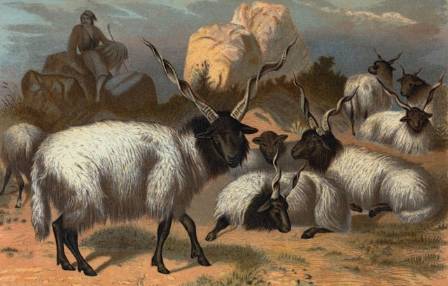
Spanning more than ten centuries of bucolic imagery.
1. Edgar Barclay, The Shepherd
Focusing more on the atmosphere of the heavens than the terrain itself, this work emphasizes the herdsman's intimate tie to the natural world and the open air—specifically the thrill of a clear day spent on Salisbury Plain. London-born artist Edgar Barclay (1842–1913) received his artistic training in Germany and Italy. Upon his return to England during the 1880s, he became deeply involved in documenting the countryside of Wessex, with a particular interest in the stones of Stonehenge. Shepherds and their flocks are recurring motifs in his portfolio. Coincidentally, in 1910, WH Hudson penned his iconic volume, The Shepherd’s Life, inspired by these same Wiltshire landscapes.
2. Anton Mauve, The Return to the Fold, 1873
It is uncommon for pastoral art to showcase such raw, muddy ground. In this piece, a flock is guided back to their enclosure during the winter months. As a prominent figure in The Hague School, Anton Mauve (1838–88) was related to Vincent van Gogh through marriage and utilized the global network of Van Gogh’s uncle, an art dealer. Mauve’s depictions of shepherds were incredibly popular with American collectors; tradition holds that he adjusted his fees based on the perspective of the sheep, charging more if they faced the viewer. Since the animals here are moving away, this represents a more modest investment for the original buyer.
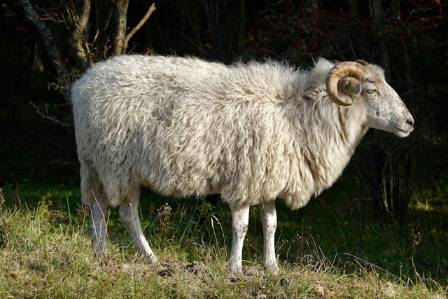
3. Jean-François Millet, Shepherdess with her Flock, c. 1863
This glowing image of a young girl tending her sheep earned Jean-François Millet (1814–75) high praise from critics when it debuted at the Paris Salon in 1864. Bathed in a warm, amber glow, the painting projects a sense of peaceful unity—the animals graze quietly while the shepherdess focuses on her handiwork. This idealized vision of youth proved more commercially successful than Millet’s grittier depictions of farm laborers. The theme became a favorite for the artist, who created several iterations, including four pastels based on this specific composition. The girl in the painting was modeled after Millet's own daughter, Louise, and the setting reflects the plains near his Barbizon residence.
4. Edwin Henry Landseer, A Highland Shepherd's Home, c. 1836
This selection is included primarily for its unique premise: a pastoral scene set entirely indoors! Edwin Henry Landseer (1802–73) produced this work for John Sheepshanks, a prominent patron who affectionately dubbed it his "Scottish holy family." The painting functions as a peculiar Nativity scene where the traditional figures of Mary and Joseph take on the guise of shepherds, all situated within the confines of a modest Victorian-era cottage.
5. Aelbert Cuyp, Herd of Sheep at Pasture, c. 1645 – 55
The appeal of this artwork lies in its blend of sophisticated Italian lighting—specifically a warm, Venetian-style radiance—with a traditional Dutch country setting. The herdsman resting on his staff and his watchful canine companion are rendered with a natural fluidity. However, like many painters of his era, Aelbert Cuyp (1620–91) found sheep difficult to render accurately; his animals here possess the proportions and facial features more reminiscent of llamas than livestock.
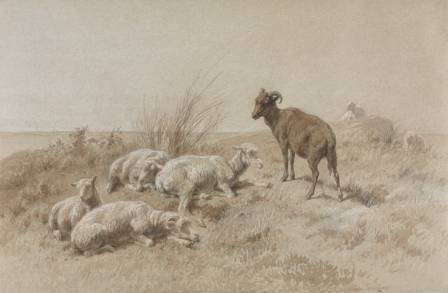
6. Giorgione, The Adoration of the Shepherds, 1505–10
Despite being a world-renowned Renaissance interpretation of this biblical event, the painting lacks any actual sheep. The herdsmen depicted have arrived so quickly to witness the holy birth that their flock was left behind. Nevertheless, Giorgione (c. 1473–1510) maintains a pastoral essence through the inclusion of a vibrant landscape and sky visible in the background. The men kneel in reverence before the infant Christ, their poverty and low status indicated by their tattered, frayed garments.
7. The Good Shepherd Fresco, Catacombs of Priscilla, Rome, c. 225 AD
Found on the curved ceiling of an ancient burial vault—the Cubiculum of the Veiled Woman—this early piece of Christian art depicts the Good Shepherd as mentioned in the Gospel of John, symbolizing Christ's sacrifice for his followers. The figure is positioned in a heavenly garden, flanked by trees containing a peacock and a dove. To one side is a sheep and to the other a goat, representing the final separation of the righteous from the wicked during the Last Judgment. While the meaning is Christian, the style also draws on Roman funerary customs where shepherd figures represented the calm and peace expected in the afterlife.