← वर्कस्पेस3 मिनट
नोट
Basic information & taxonomy
Common names: Western rockhopper penguin (sometimes also lumped with “southern rockhopper penguin”) Scientific name: Eudyptes chrysocome (Forster, 1781)
N
Noah Davis
लेखक
मेटा
संदर्भ फील्ड नीचे उपलब्ध।
टाइप
पल्स नोट
Common names: Western rockhopper penguin (sometimes also lumped with “southern rockhopper penguin”)
Scientific name: Eudyptes chrysocome (Forster, 1781)
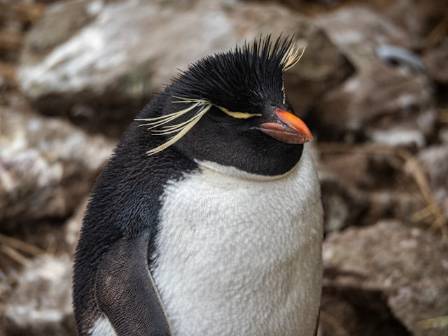
It is one of the “crested penguins,” characterized by prominent yellow crest feathers above the eyes.
There has been debate among taxonomists about how many distinct species or subspecies of rockhopper penguins there are. Some treat the Western form as distinct from the Eastern and Northern rockhoppers; others treat them all as subspecies of Eudyptes chrysocome.
Within that framework, E. c. chrysocome is the “western” subspecies (i.e. the form breeding off South America) and E. c. filholi is the “eastern” or Indopacific subspecies.
The northern rockhopper penguin, Eudyptes moseleyi, is genetically distinct and often treated as a separate species.
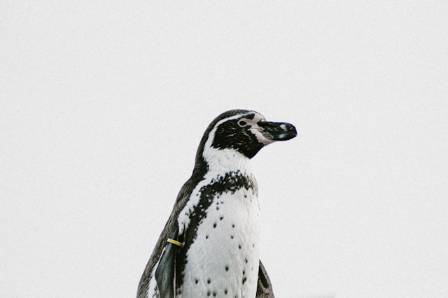
Description & size
Among the Eudyptes (crested) penguins, this is the smallest yellow-crested black-and-white penguin.
Size: ~ 45 to 58 cm in length (~18 to 23 inches)
Weight: generally 2.0 to 3.4 kg (4.4 to 7.5 lb), though some exceptional individuals weigh up to ~4.5 kg (≈9.9 lb)
Upper parts: slate-gray or dark; head, face and back dark; underparts white with sharp demarcation at throat.
Crest: The yellow “eyebrow” stripe starts about 1–2 cm above the gape, broadening into a wedge in front of the eye, and behind the eyes the crest feathers droop sideways.
Bill & eyes: The bill is orange-red. The eyes are red. The skin at the base of the bill is black (i.e. there’s no pale or fleshy skin there, which helps distinguish it from some related forms).
Legs & feet: Pink with black soles.
Immature birds: somewhat smaller, with greyer throat and less well developed crests.
Ecology, behaviour & diet
Habitat & distribution: Breeds in subantarctic islands off southern South America (e.g. Falkland Islands, islands off Patagonia). The “western” form’s stronghold is around the Falkland Islands.
Outside breeding season: individuals disperse widely into surrounding ocean waters.
Diet: Primarily crustaceans (krill, etc.), but also squid, octopus, small fish (lantern fish), mollusks, and cuttlefish.
Foraging & dives: • They use both pelagic dives (shallower, in open water) and benthic dives (near the seafloor). • Benthic dives can reach up to ~100 m (≈ 330 ft) depth. • Dive duration: typical aerobic dives are limited to ~110 seconds; some dives may last up to ~180–190 seconds (i.e. pushing physiological limits) • Females generally forage during the day, making multiple dives in trips lasting many hours. Occasionally they might forage at night, but nighttime dives tend to be shallower. • They may range far: foraging trips up to ~157 km (≈ 98 miles) from the colony have been documented.
Locomotion on land: Unlike many penguins that slide (toboggan) on their bellies, rockhoppers “hop” over rocks and boulders, hence their common name.
Breeding & reproduction: • They breed in colonies on cliffs, rocky shores, sometimes inland or up cliffs. • Breeding season: September to November (in the Southern Hemisphere) • Clutch size: usually two eggs are laid, but typically only one chick is successfully reared (the first egg often fails). • Incubation: ~ 35 days • After hatching: chicks are brooded for ~26 days before being left more independently.
Longevity: One known individual (“Rocky”) in captivity lived to ~ 29 years and 4 months (in a Norwegian aquarium).
Conservation status & threats
The global population is estimated at around 1 million pairs (i.e. ~2 million adult birds) for the rockhopper complex, with a large share belonging to the E. c. chrysocome (western) population.
Population trend: The western rockhopper (and rockhoppers generally) has experienced substantial declines — about a one-third drop over the last ~30 years (as of the time of the article)
Threats: • Commercial fishing (competition for prey, bycatch) • Oil spills and pollution in ocean waters
Status: Classified as Vulnerable by the IUCN.
Human interactions: • Historically, indigenous peoples (e.g. the Yahgan people in Tierra del Fuego) hunted them for food. • Today, their colonies attract ecotourism, which can have both benefits (awareness, protection) and risks (disturbance) • In captivity / zoological settings: European zoos coordinate breeding programs; Drusillas Park in East Sussex holds the studbook for rockhopper penguins in Europe.